

So you want to know how to draft a plaint? Okay, good. This is one of those things every law student gets confused about at the start. A plaint is the first paper in a civil suit, so if the plaint is messy, the whole case starts messy.
The good news is that a plaint follows one fixed pattern. Learn the pattern once and you can draft almost any civil plaint under the CPC.
In this guide I will go through each part in the same order you write it. I have also added a sample plaint so you can see how every part actually looks. All the names, addresses, dates and amounts in the sample are made up.
One quick note. This post is only about civil suits under the Code of Civil Procedure. Consumer cases, criminal complaints and labour court cases have their own formats.
What is a plaint?
A plaint is the written statement a plaintiff files in court to start a civil suit. Order VII of the Code of Civil Procedure, 1908 says what it must contain. The person who files is the plaintiff, and the person being sued is the defendant.
Our sample is a landlord suing his tenant for eviction and unpaid rent. It is a simple case, so it is easy to follow.
How to draft a plaint: the 12 steps
Here they are in the order you write them. Follow the order and you will not miss anything.
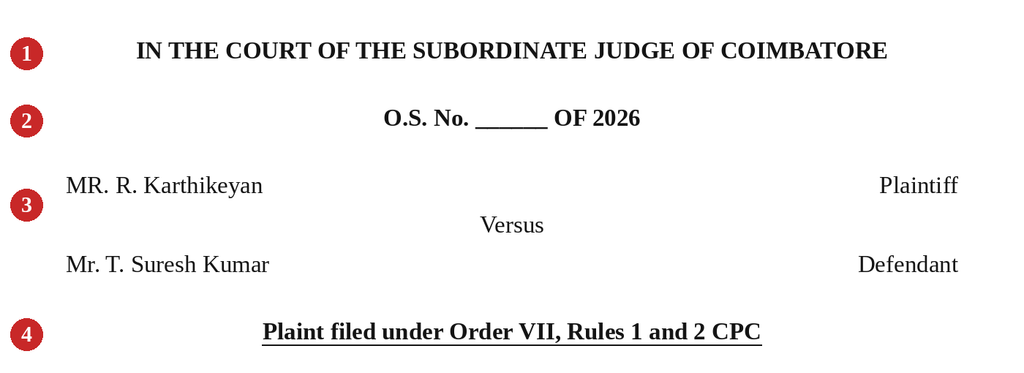
Step 1: Title of the court
The first thing you write is the name of the court. Now you may ask, how do I know which court it will go to?
Take a district with five additional district courts, or three additional sub courts. They all hear the same type of cases. Before you file, you do not know which one you will get. So do not write a court number and do not write the judge’s name.
Just look at the value of your claim and write the level of the court, like Munsif Court, Sub Court or District Court. For example: In the Court of the Subordinate Judge of Coimbatore. Court names change from state to state, so check what your local court is called.
Step 2: Case number
Next is the case number. Write O.S. No. ___ of 2026. O.S. means Original Suit.
Leave the number blank. The court registry gives it only after you file. The year is just the year you are filing in.
Other cases have other codes, like MCOP for motor accident claims, RCOP for rent control and HMOP for Hindu marriage petitions. For a regular civil suit it is O.S.
Step 3: Names of the parties
Write the plaintiff’s name, then Versus, then the defendant’s name. In civil suits we say plaintiff and defendant. In consumer cases they are called complainant and opposite party, so do not mix that up.
If there is more than one defendant, just number them. First defendant, second defendant and so on.
Step 4: Heading of the plaint
Now write Plaint filed under Order VII Rule 1 CPC. Rule 1 lists everything a plaint must have.
If you want money back from the other side, add Rule 2 also. Rule 2 says you must state the exact amount you are claiming. Rule 14 is for your documents, and we will come to it at the end.
Here is how steps 1 to 4 look together in the sample. The red numbers match the steps.
Step 5: Details of the plaintiff and defendant
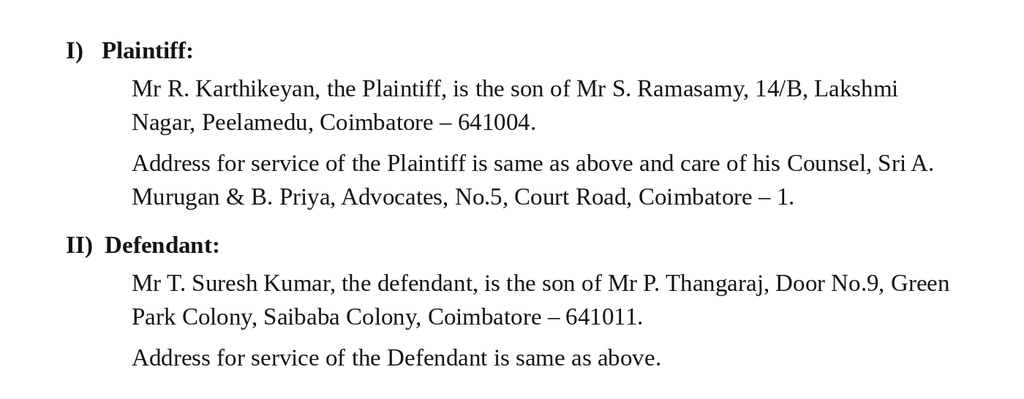
Now the real drafting starts. Use Roman numbers. Paragraph I is the plaintiff and paragraph II is the defendant. Make both headings bold and underlined.
Write the name, the father’s name and the full address. For the plaintiff, also write the address for service. Usually this is care of his advocate.
For the defendant, you will not know his advocate yet. So just write that his address for service is the same as his address above.
Step 6: Facts of the case
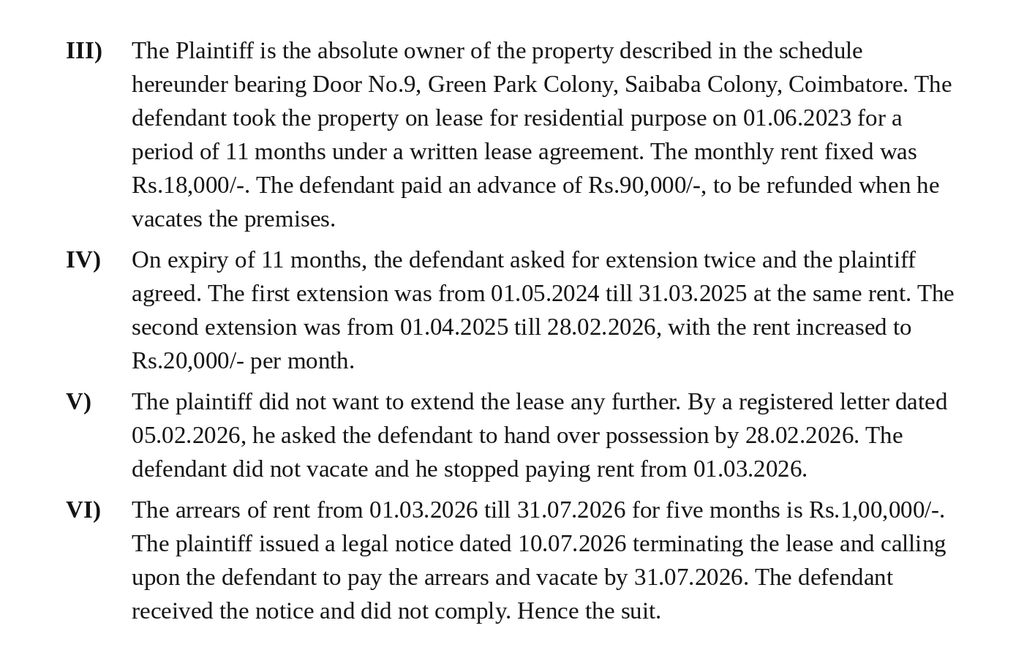
From paragraph III, you tell the story. Three things to remember.
- Write in chronological order, one event after another.
- Never repeat a fact in two paragraphs.
- Keep each paragraph short.
In a money suit, you say when the money was given, how much, when it was to be returned, and what happened after that. In our sample it is the lease, the two extensions, the notice and the unpaid rent.
Also, write only the material facts. Order VI Rule 2 CPC says a pleading should have facts, not evidence and not law. Your documents are the evidence, and they go in the list at the end.
Step 7: Cause of action
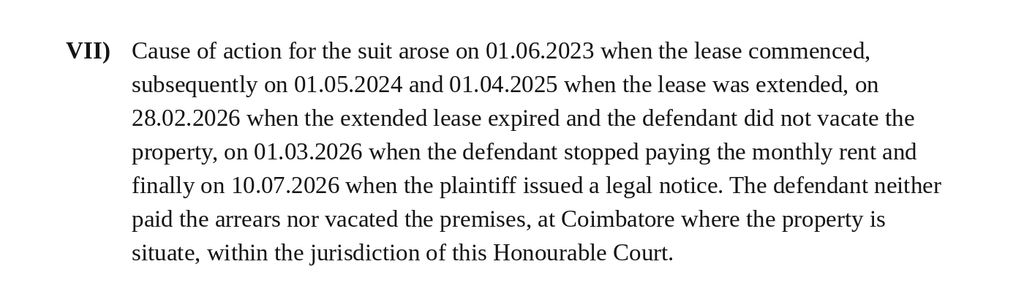
The cause of action comes after the facts. A lot of people get confused here, so let me make it simple.
Cause of action means the facts that give you the right to sue. It arises when the other side violates your right. So write the dates of each event, and also the place where it happened.
The place matters because it shows the court has territorial jurisdiction. In our sample the property is in Coimbatore, so the Coimbatore court can hear the case.
The date you came to know about something is a different thing. That matters for limitation. If your suit looks late, Order VII Rule 6 says you must state why it is still within time.
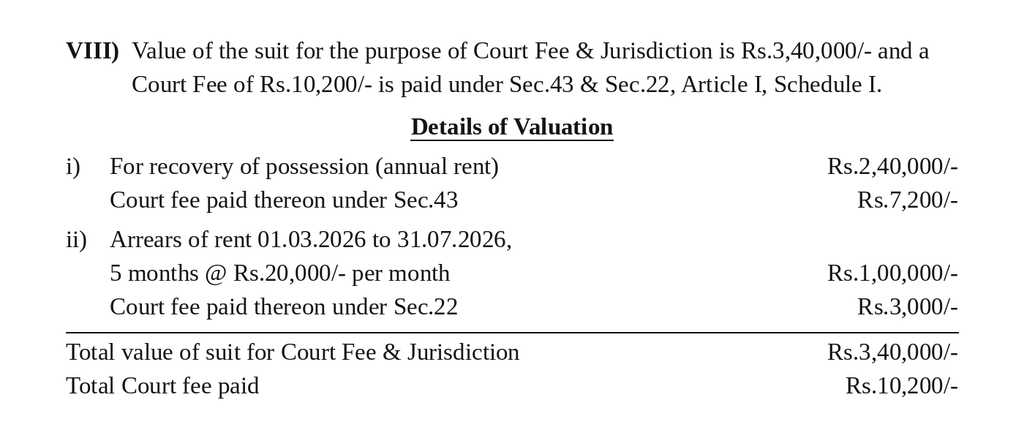
Step 8: Valuation and court fee
Next you state the value of the suit for court fee and jurisdiction. Court fee is a state subject, so use your own state’s Court Fees Act. In Tamil Nadu it is the Tamil Nadu Court-Fees and Suits Valuation Act, 1955.
Give a small breakup for each relief and the court fee paid on each one. In our sample the fee works out to 3 percent of each amount. Always check the current Act and schedule for your state, because rates can change.
Calculating the exact court fee needs its own post, so I will do that separately.
Step 9: Prayer and signatures
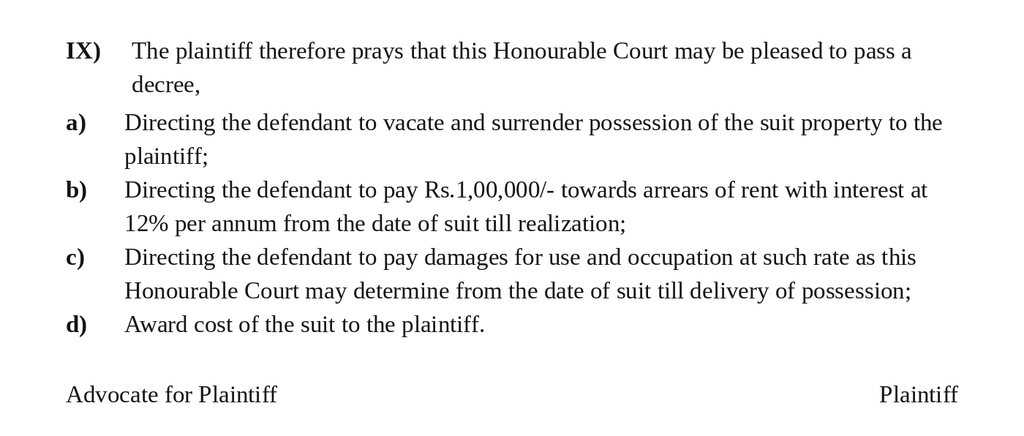
The prayer is where you ask the court for what you want. List each relief as a), b), c), d). In the sample it is possession, arrears of rent with interest, damages for use and occupation, and the cost of the suit.
The court can only give what you ask for. So do not skip any relief, and make sure the prayer matches the facts you pleaded.
After the prayer, write Advocate for Plaintiff on the left and Plaintiff on the right.
Step 10: Verification
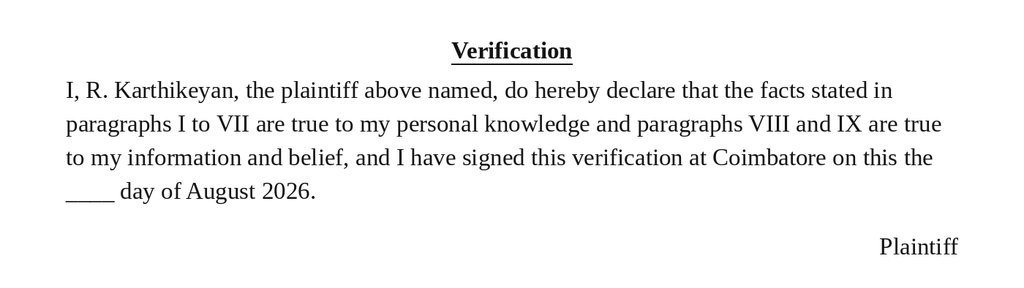
The plaintiff now confirms that he has read the plaint and that the facts are true. That is what the verification is for.
Under Order VI Rule 15, it is better to say which paragraphs are true to his own knowledge, and which are true to his information and belief. Add the place and the date.
Step 11: Description of property
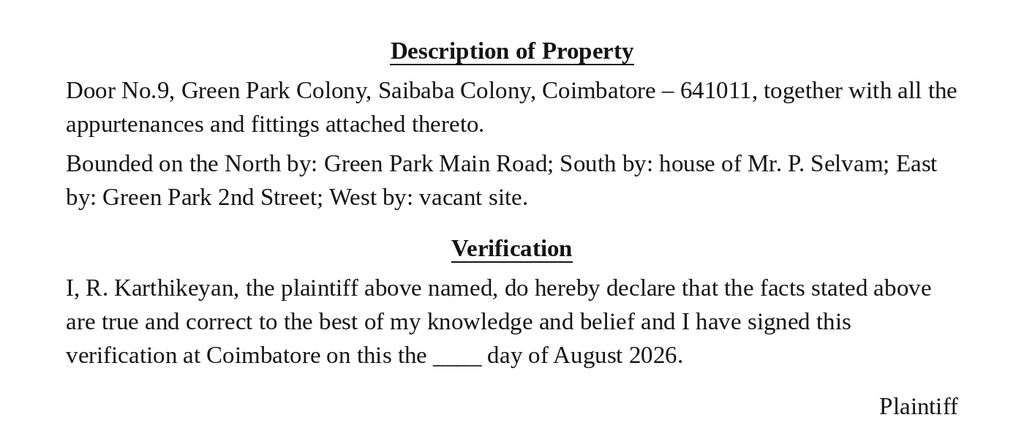
If the suit is about immovable property, describe it so clearly that anyone can identify it. Write the door number, survey number, extent, village and the four boundaries. Order VII Rule 3 requires this.
Then add a separate verification for the description of property.
Step 12: List of documents
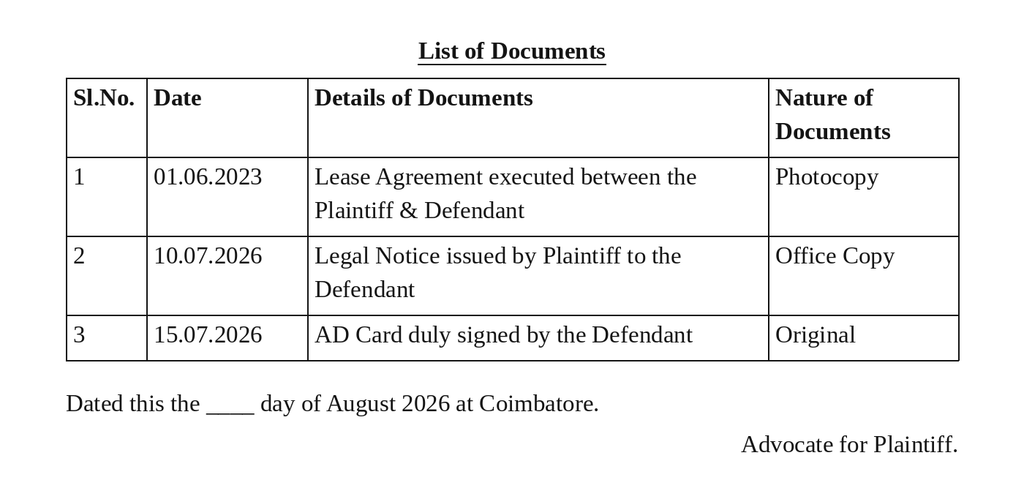
Under Order VII Rule 14, you must list the documents you rely on and file them with the plaint. Write the serial number, the date, the details of the document, and whether it is an original, a photocopy or an office copy.
Finally, write Dated this the ___ day of ______ 2026 at Coimbatore, and sign as Advocate for Plaintiff.
Common mistakes to avoid
- Writing a court number or the judge’s name in the title.
- Repeating the same fact in many paragraphs.
- Putting evidence and legal arguments inside the plaint.
- Forgetting a relief in the prayer.
- Skipping the place in the cause of action paragraph.
- Paying the wrong court fee.
These are not small things. Under Order VII Rule 11, a court can reject a plaint if it shows no cause of action, if the relief is undervalued, if the court fee paper is not enough, or if the suit is barred by law.
Quick checklist
- Court title, with no judge name
- Case number left blank, year filled
- Parties
- Order VII Rule 1 heading (plus Rule 2 for money)
- Plaintiff and defendant details in Roman numbers
- Facts in order, no repetition
- Cause of action with dates and place
- Valuation and court fee
- Prayer and signatures
- Verification
- Description of property
- List of documents, date and signature
FAQs on drafting a plaint
Which rule says what a plaint must contain?
Order VII Rule 1 of the CPC lists the particulars every plaint must contain. You can read the full text in the Order VII bare act or this explainer on Order 7 Rule 1.
Can a plaint be rejected?
Yes. Order VII Rule 11 gives the grounds, like no cause of action, undervaluation, insufficient court fee and a suit barred by law. A court can also reject it if you do not file the process fee and copies on time under Rule 9.
Do I write the judge’s name in the title?
No. Before filing you do not know which court will get the case, so write only the court designation, like Subordinate Judge of Coimbatore.
What is the difference between a plaint and a written statement?
The plaintiff files the plaint to start the suit. The defendant files the written statement as his reply to it.
Final thoughts
A plaint does not need to be long. It needs the right facts in the right order, a clear cause of action and a clear prayer. Once you understand this pattern, drafting becomes much easier.
This post is for learning and is not legal advice. Court rules and court fee rates differ from state to state, so always check the bare act and your local rules before you file.