

Introduction
Ravi lent ₹2 lakhs to his friend. The repayment promise came over WhatsApp, “I’ll return it by March, bro.” When his friend denied it in court, Ravi pulled out his phone. The judge asked one question: “Do you have a Section 63 certificate?” Ravi had no idea what that meant. He lost the case.
That one certificate could have changed everything. This article tells you exactly what it is and how to use it.
If you want to follow lawnote.in, If you have any questions or queries or want to contact me, feel free to, [Click Here]
Is WhatsApp Evidence Legally Valid In India?
Yes, WhatsApp evidence is legally valid in India, but there is a catch.
The WhatsApp messages are classified as electronic records under the IT Act, 2000. This applies to emails, computer files and any form of digital documents. The law recognises them. Lawyers have used them to win cases.
Now, let’s see which provision states that WhatsApp evidence is legally valid
The Law Behind WhatsApp Evidence
The law behind the WhatsApp evidence is Section 65B of the Indian Evidence Act, 1872 / Section 63 of the BSA, 20231. In 2023, there was a major change in the Evidence Act of 1872. Case filed before 2023? Cite Section 65B of the Indian Evidence Act. Case filed after 2023? Cite Section 63 of the BSA.
Simple rule
- Case filed before BSA came into force → Section 65B, Indian Evidence Act
- Case filed after BSA came into force → Section 63, Bharatiya Sakshya Adhiniyam
Even after the change of law, the provision stayed intact, which means the content of the provision did not change.
Let’s take a look at some of the key clauses in Section 63 of BSA, 2023.
Section 63, Bharatiya Sakshya Adhiniyam 2023
Section 63(1) Notwithstanding anything contained in this Adhiniyam, any information
contained in an electronic record which is printed on paper, stored, recorded or copied in
optical or magnetic media or semiconductor memory which is produced by a computer or
any communication device or otherwise stored, recorded or copied in any electronic form
(hereinafter referred to as the computer output) shall be deemed to be also a document, if
the conditions mentioned in this section are satisfied in relation to the information and computer in question and shall be admissible in any proceedings, without further proof or
production of the original, as evidence or any contents of the original or of any fact stated
therein of which direct evidence would be admissible.
Section 63(4) In any proceeding where it is desired to give a statement in evidence by virtue of this section, a certificate doing any of the following things shall be submitted along with the electronic record at each instance where it is being submitted for admission, namely:—
(a) identifying the electronic record containing the statement and describing
the manner in which it was produced;
(b) giving such particulars of any device involved in the production of that
electronic record as may be appropriate for the purpose of showing that the electronic
record was produced by a computer or a communication device referred to in clauses (a)
to (e) of sub-section (3);
(c) dealing with any of the matters to which the conditions mentioned in
sub-section (2) relate, and purporting to be signed by a person in charge of the computer or communication device or the management of the relevant activities (whichever is appropriate) and an expert shall be evidence of any matter stated in the certificate; and for the purposes of this sub-section it shall be sufficient for a matter to be stated to the best of the knowledge and belief of the person stating it in the certificate specified in the Schedule.
The above section 63(1) explains what all is electronic evidence is, and section 63(4) explains the need for the certificate to be submitted along with the evidence in court.
Now, why does this certificate matter so much?
The Supreme Court answered this clearly in Arjun Panditrao Khotkar v. Kailash Kushanrao Gorantyal (2020)2. The court held that the certificate is not optional; it is mandatory for electronic evidence to be admissible. No certificate means the opposite party can object to your evidence at the very first stage, and the court can refuse to look at it entirely.
The Delhi High Court went even further in Dell International Services India Pvt. Ltd. v. Adeel Feroze (2024)3, holding that WhatsApp message printouts and screenshots cannot be read as evidence without the mandatory certificate under Section 63 BSA or Section 65B IEA.
It does not matter how clear, genuine, or damaging those messages are. Without the certificate, they are invisible in court.
How To Produce WhatsApp Evidence In Court
There are two methods to produce WhatsApp evidence in court. Let’s go one by one.
Method: 1 Export Chat
This is the legally safer and more structured method. Here is how to do it step by step:
How to export a WhatsApp chat on Android:
- Open the specific WhatsApp chat
- Tap the three dots (⋮) on the top right
- Tap More → Export Chat
- Choose “Include Media” if images, audio, or documents are relevant to your case — otherwise “Without Media” for text only
- Save or send the exported .txt file to yourself
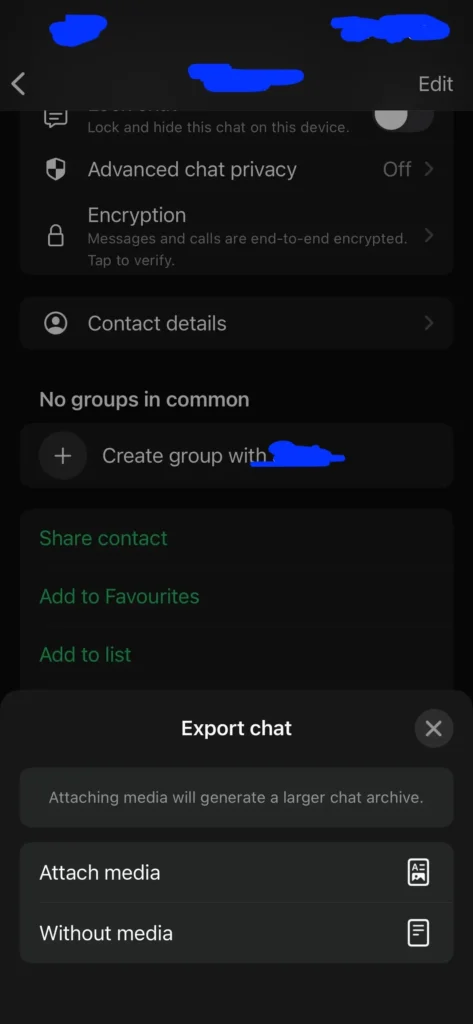
How to export on an iPhone:
- Open the chat
- Tap the contact name or number at the top
- Scroll down and tap Export Chat
- Choose with or without media
- Save the file
Now, what to do after exporting !!!
Now, copy the entire .txt file, paste it into a Word document, perform basic alignment, and apply basic formatting to improve readability. Don’t cherry-pick each text. Just paste the entire text, and that gives us confidence in the Court. If you have media, print it separately and then arrange everything in chronological order, make sure the mobile number is visible and then attach the section 63 certificate.
[Download Section 63 Certificate]
Method 2: Screenshots
Screenshots are commonly used when the conversation is very long and only specific messages are relevant. This method is acceptable but comes with risks. I personally don’t suggest this method.
Best practices if you use screenshots:
- Always make sure the mobile number is visible in the screenshot, not just the saved name
- Screenshot the contact info page showing the number separately
- Never screenshot selectively, if you are screenshotting a particular date or topic, include all messages from that date or on that topic, selective screenshots can be objected to on grounds of hiding context
- Never edit, crop, or enhance the screenshot in any way
- Note the date and time you took the screenshot, on Android, this is visible in the file name itself
For example, an Android screenshot file name looks like this:
Screenshot_2026-03-05-08-36-11
This tells you the screenshot was taken on 5th March 2026 at 8:36 AM — record this in your Section 63 certificate
- Number your screenshots and arrange them in chronological order
- Attach the Section 63 BSA certificate with all screenshots
[Download Section 63 Certificate]
Why Method 1 is a Stronger Form of Evidence
The exported file carries dates and timestamps automatically. It’s harder for the opposite party to challenge, and it shows the complete conversation. Even the courts prefer this method over method 2.
Why Method 2 is Weaker
It’s simple, the screenshots can be edited 🙂
The Section 63 BSA Certificate
By now, you know that without this certificate, your WhatsApp evidence is worthless in court. But what exactly is this certificate? What does it say? And where do you actually get it made?
Let’s break it down simply.
What Is The Section 63 Certificate?
Think of it like an affidavit, A sworn statement to the court declaring that everything you have submitted is genuine, complete, and correct.
Who Signs It?
Under Section 63(4) BSA, the certificate must be signed by the person in charge of the device, which in most cases is simply you, the phone owner.
You do not necessarily need a technical expert to sign it in straightforward cases. However, if the opposite party seriously challenges the authenticity of your chats, a forensic expert’s supporting certificate can strengthen your case significantly.
Sample Section 63 BSA Certificate
THE SCHEDULE
[See section 63(4)(c)]
CERTIFICATE
PART A
(To be filled by the Party)
I, _________ (Name), Son/daughter/spouse of _______
residing/employed at ______________ do hereby solemnly affirm and sincerely
state and submit as follows:—
I have produced electronic record/output of the digital record taken from the following
device/digital record source (tick mark):—
Computer / Storage Media □ DVR □ Mobile □ Flash Drive □
CD/DVD □ Server □ Cloud □ Other □
Other: ____________________________
Make & Model: ___ Color: ___
Serial Number: ___
IMEI/UIN/UID/MAC/Cloud ID_____________________ (as applicable)
and any other relevant information, if any, about the device/digital record____(specify).
The digital device or the digital record source was under the lawful control for regularly
creating, storing or processing information for the purposes of carrying out regular activities
and during this period, the computer or the communication device was working properly and
the relevant information was regularly fed into the computer during the ordinary course of
business. If the computer/digital device at any point of time was not working properly or out
of operation, then it has not affected the electronic/digital record or its accuracy. The digital
device or the source of the digital record is:—
Owned □ Maintained □ Managed □ Operated□
by me (select as applicable).
I state that the HASH value/s of the electronic/digital record/s is _____,
obtained through the following algorithm:—
□ SHA1:
□ SHA256:
□ MD5:
□ Other__________________ (Legally acceptable standard)
(Hash report to be enclosed with the certificate)
(Name and signature)
Date (DD/MM/YYYY): _ Time (IST): ______hours (In 24 hours format) Place: ______
Legal Traps That Can Get Your WhatsApp Evidence Rejected
- Your Original Phone Is Gone. If authenticity is challenged, courts may ask for the original device. People change phones every two years. By the time your case reaches the evidence stage, that phone is long gone.
- Saved Name Instead of Number “Landlord Ravi” means nothing to a court. Always show the actual mobile number, and screenshot the contact info page separately.
- Deleted Messages Export chats early. Once messages are deleted, especially “Delete for Everyone“, the damage to your evidence is very hard to fix.
- Emoji Reactions: A 👍 is not a legal agreement. If your entire case depends on an emoji, you are going to struggle in court.
- Selective Screenshots Only screenshotting the messages that favour you is a bad idea. Courts can demand the full conversation, and if you have hidden something, it destroys your credibility.
WhatsApp Evidence In Specific Situations
Situation 1: Divorce And Matrimonial Cases
This is where WhatsApp evidence appears most frequently in Indian courts today. Messages between spouses are being used to prove cruelty, adultery, financial disputes, and child custody matters.
The Madhya Pradesh High Court in Smt. Anjali Sharma v. Raman Upadhyay (2023)4 allowed a husband to produce his wife’s WhatsApp chats to support allegations of adultery in a divorce proceeding. The court held that while the right to privacy is fundamental, it is not absolute, and may yield to the right of a fair trial.
Situation 2: Money Disputes And Loan Cases
“I will return it by March bro”, sent over WhatsApp, has actually held up in court. Promises of repayment, acknowledgements of debt, and financial agreements made over WhatsApp are increasingly being used as evidence in money recovery cases.
What works as evidence here:
- A message promising to repay a specific amount by a specific date
- An acknowledgement that money was received
- A voice note confirming a financial agreement
- Payment screenshots shared over WhatsApp
Conclusion
WhatsApp has changed the way we communicate. Deals are made on it. Promises are broken on it. Relationships are built and destroyed on it. It was only a matter of time before it became a regular feature in Indian courtrooms.
But as we have seen throughout this article, producing WhatsApp evidence in court is not as simple as showing the judge your phone screen. The law is clear, the process is specific, and the mistakes are costly.